
|
Added
Apr 14, 2018
Location
Views
2309
Rating
  (4 votes, average: 4.00 out of 5) (4 votes, average: 4.00 out of 5) Loading... Loading... |
Welcome to Nurture.We take this opportunity to present to you Nurture, Schools of the Future, an international programme by which schools get complete support to implement a world class curriculum
The Nurture international affiliate and franchise programmes support schools to become lighthouses of society.
Formative reports help parents understand their child’s strengths and weaknesses at a glance .
Nurture is powered by GEMS — The Global Education Model of Schooling of the Council for Global Education, USA.
Universal values
Global understanding
Excellence in all things
Service to humanity
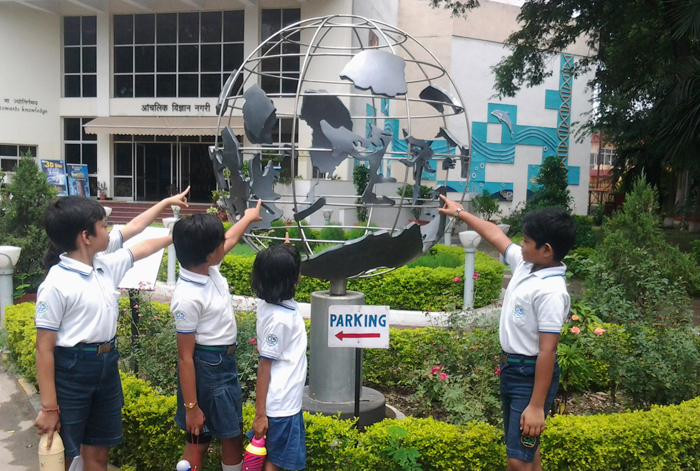
A good education is one that nurtures.
We take this opportunity to present to you Nurture, Schools of the Future, an international programme by which schools get complete support to implement a world class curriculum and assessments based on the Council for Global Education’s Four Building Blocks of Education in the 21st Century: Universal Values, Global Understanding, Excellence in All Things, and Service to Humanity, and the premise of ‘Compete with Yourself!’.
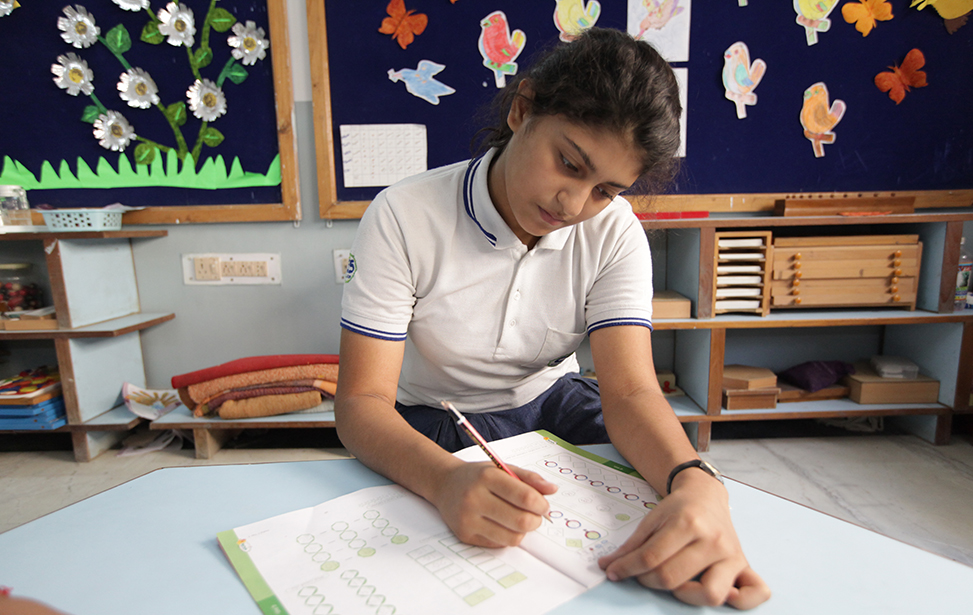
In Nurture, school transformation means preparing children who are:
Nurture now offers India’s most comprehensive education support programme for existing and new schools for PreK-12, and beyond that, preparation for competitive examinations. Like a DNA, learning for a child goes a child moves from strength to strength goes from one point to the next in a dynamic spiral upwards, similarly reaching for perfection at each level of understanding.
To make this possible, nurture’s approach to teaching and learning is based on the premise of ‘Compete with Yourself’, the only premise capable of bringing out the best in every child. Ongoing research at our experimental schools has led to the incorporation of the Nurture Process of Perfection
Nurture is a outcomes driven, values laid process of transformation at a school. It’s driven by its mission to make education more meaningful for the individual child and to create conscious and caring individuals for whom service to humanity will become a way of life. They will become both leaders and team builders, not just competitors. They will be intrinsically motivated to do their best always and to compete with themselves, not others. They will be able to distinguish right from wrong & will always chose to do that which is worthy of human nobility.
Signifies attainment of material comfort and ease
Signifies civilization and progress
Signifies acquisition of divine perfections
Nurture is a rounded education of body, mind, heart and spirit of each child.
| Rate of learning | Type of learning | Attention span | Motivation Levels |
|---|---|---|---|
| (fast and slow learners) | (visual, audio, motor, mixed, as per individual learning styles) | (provides a variety of methods to hold their attention) | (builds and nurtures intrinsic motivation) |

Principal, KiderBrook, Pune, Maharashtra
Principal, Little Steps, Bhuj, Gujarat
My experience is almost magical. Once I saw the Perbooks and the MAXIMs, there was no looking back. It is a wonderful world of education.
The students become so fast in learning! Children learn a lot more. In fact, they don’t want to go out to play…All the children, everybody gets a chance and assessments cover every part of learning. It’s a whole different world.
The books train the teachers. Teachers are so excited, they want to add and create.
You feel like there’s an extended family there for you with Nurture. This whole revolution should be in the entire country and more and more schools should take this up.”
Principals, Secondary & Junior Schools, Sharada Mandir School, Goa
“We have been enthusiastic participants in the GEMS mathematics program from June 2007. The Maxim books with their interactive and illustrative exercises are both useful and interesting. The children have enjoyed the ‘hands-on’ activities which have helped them assimilate concepts in simple, effective and practical ways.”
Principal, W. H. Smith Memorial School, Varanasi
“Wonderful series! It shows that the author has a deep rooted knowledge of the problems of students, teachers and parents. Very effective for the teaching of English.”
“GEMS Maths and English books are very much informative and cover wide range of topics in the subject. These books improve practical skill of a student in an effective way.”
“GEMS is a good and simpler way to teach a student all basics and fundamentals. A student can easily grasp the things through the examples given in the chapters.”
“They are self-explanatory; the topics are made clear step-wise and thus create interest in the student and promote self-study and competition with oneself.”
“GEMS materials introduced in this current session have made a tremendous change in [children’s] understanding of topics.”
“Simple and easy techniques have been adopted to make every topic easy [to understand].”
“Innovative methods make each and every topic interesting.”
“A student takes keen interest and is engrossed in doing the books independently.”


 |
GEMS Nurture Perbooks (Personalized Workbooks) were the first set of materials made as part of the Icelandic pilot on the premise of compete with yourself. Perbooks are matched to every child’s personal needs |
 |
Dr Jagdish and Dr Mrs Bharti Gandhi,Founders, City Montessori School (CMS)receiving the UNESCO Peace Prize at UNESCO Headquarters, Paris, 2002 |
 |
GEMS Nurture team in Iceland sharing initial findings of the Nurture maths programme with Prof. Howard Gardner, Ellen Winner, David Monetti, Bill Huitt and other education experts. Experimental work for Nurture began in Iceland. |
 |
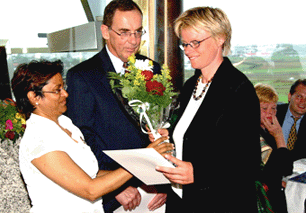
Dr Sunita Gandhi with top educators of Iceland at an awards ceremony organized by the Education Society of Iceland (Islensku menntasamtokin ses), a non-profit education society started by her in 2000 when her first experiments with GEMS Nurture began in the live laboratory of Aslandsskoli, |
 |
Dr Sunita Gandhi on extreme right with family at UNESCO Headquarters, Paris, at the Awards Ceremony |

  |
|
 |
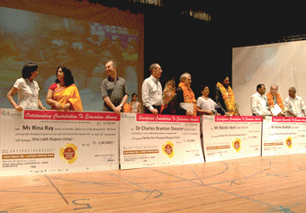 |
| Principals and teachers are appreciated for their work. Here, Dr Robert Saunders and Dr Sunita Gandhi, Co-Founders, Council for Global Education, USA, present awards and recognition to teachers and Principals in Iceland. |
In India, recognition is provided at the nationwide level through Ed Leadership Roundtables (www.edleader.in). |
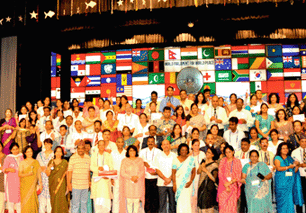 |
| In August 2010, 112 individuals from schools across India were awarded the Ed Leader Innovation In-Process Fellowships and other Awards. |
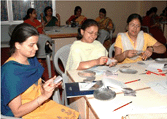
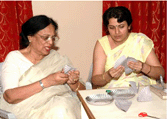
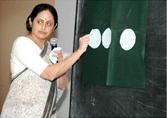
Nurture’s teaching methods include personalised and differentiated teaching techniques that involve every child in active participation using interactive, hands on and experiential learning along with accelerated teaching methods. Children learn through inquiry and constructivism and utilise their multiple intelligences. The six cognitive levels of the Bloom Taxonomy are built into the probing process to allow the development of critical thinking skills. Further more cooperative and service learning are fully integrated with a view towards the creation of team players and servant leaders (as conceptualised by Dr. Robert Greenleaf). The outcome is joyful learning, intrinsic motivation, self mastery, self analysis skills, a focus on beauty and perfection, team work and leadership skills, and a desire to serve.
Nurture Processes and Methods draw inspiration from the philosophy and works of Dr Maria Montessori (Montessori Method), Dr Rudolf Steiner (Waldorf Education), Dr Benjamin Bloom (Six Cognitive Levels), John Holt (How Children Fail), Prof. Ivan Illich (De-schooling Society), Dr Howard Gardener (Multiple Intelligences), Drs Jagdish and Bharti Gandhi (world citizenship), and the Global Education Model of Schooling of Dr Sunita Gandhi (as promoted by the Council for Global Education, USA).
Nurture utilises a range of effective strategies for capturing students interest, developing their imagination, and tapping into teachable moments. These strategies include multi age (vertical) grouping flexible time tabling, and teaching practices informed by on going diagnostics.
Nurture’s teaching and learning strategies empower children to be effective partners in their own academic development. We make use of state of the art learning resources and on going diagnostic tools in order maximise academic progress.
Instead of piece meal changes, the GEMS Nurture Affiliate Programme addresses all aspects of transformation at a school for each level the affiliate signs up for. What content is taught, how it is taught, activities and materials needed to make hands-on interactive classrooms, teacher empowerment, school ethos and environment are all integrated as part of Nurture’s holistic approach.
Based on the premise of ‘compete with yourself’, many profound changes begin to take place and a whole new outcome is witnessed for the individual child and the school community combined.
 |
 |
 |
 |
 |
|
 |
 |
Nurture’s program caters to the following developmental levels
Coursework is divided into six manageable tiers for each stage of development: Pre-Primary, Primary, Junior and Senior with clear objectives and outcomes defined for each tier of work and stage of development. The emphasis and goals vary for each stage of development and are specific to the needs for each stage, for example:
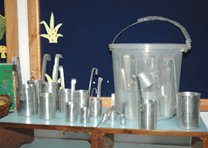
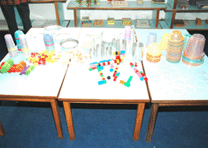
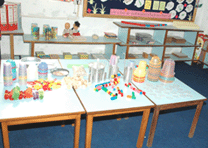
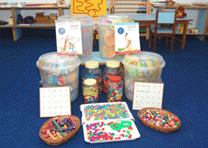
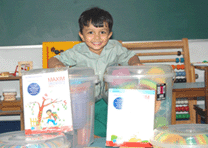
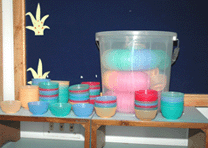
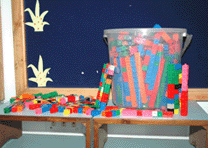
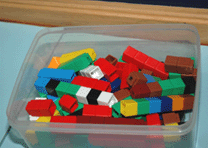
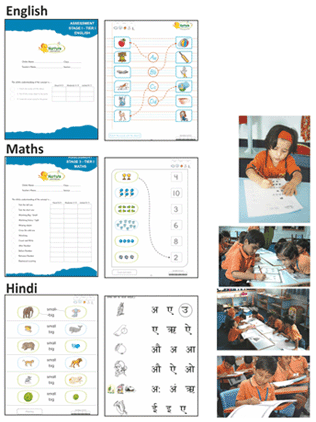
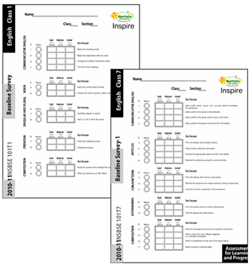
Nurture’s ground breaking and innovative approach to assessment is an integral part of what sets it apart from other products on the market. These assessment strategies put children in control of the path which their development takes, and also inform the scientific pedagogy followed by Nurture teachers. We believe that progress is a more valuable goal than accomplishment. We are therefore able to allow children to progress at their own speed in their own unique way.
 |
 |










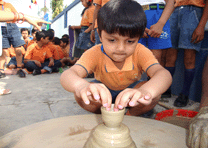
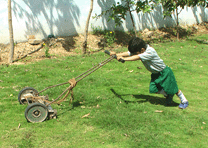
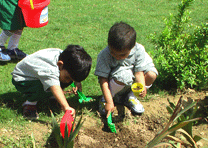


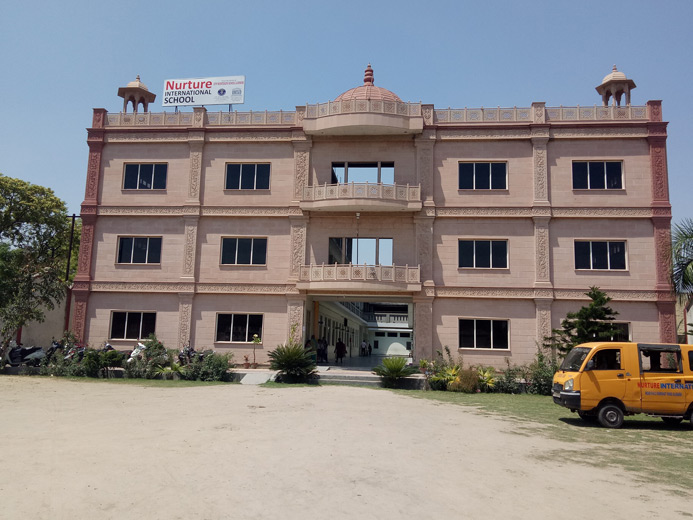
Address: Ramghat Rd, Green Park Colony, Gokuleshpuram Colony, Aligarh, Uttar Pradesh 202002












































“It is a wonderful programme.There are a lot of guidelines that help save on our energies. I think I have made a very wise decision. Our teachers have been given excellent support by the Nurture team. We I compare, I have got more than I expected.” had a training session for our teachers which equipped them to implement the materials in the programme.
The programme is child centred. It advises the teachers to go at the child’s pace. I really like the on-going diagnostics. The children can self assess [their progress]. A child can judge himself. It brings out a lot of creativity. The material is very presentable. It uses good quality paper. The programme is also flexible.
Each Tierbook has a lot of hands-on activities for the child which once a teacher sees that, even if the teacher is not trained, there are detailed guidelines for the teacher. Teachers get a ready-made syllabus.
Each activity can be done in various ways. Its focus is overall development. Its academics, show & tell, Montessori, etc. It takes in from the various good philosophies. It is not just books and materials. It is a like a whole philosophy. We are imbibing the whole ethos. I am deeply inspired.
Training can be at our convenience or training can be scheduled at our own school. The team is very approachable. I am very, very satisfied. I save on our energies. I think I have made a very wise decision. When I compare, I have got more than I expected.”